UX Board Advisory: The CX Strategy Deck Your Board Actually Wants to See
A UX board advisory engagement gives founders a board-ready CX strategy and a CX scorecard for board meetings, not a 60-page deck.


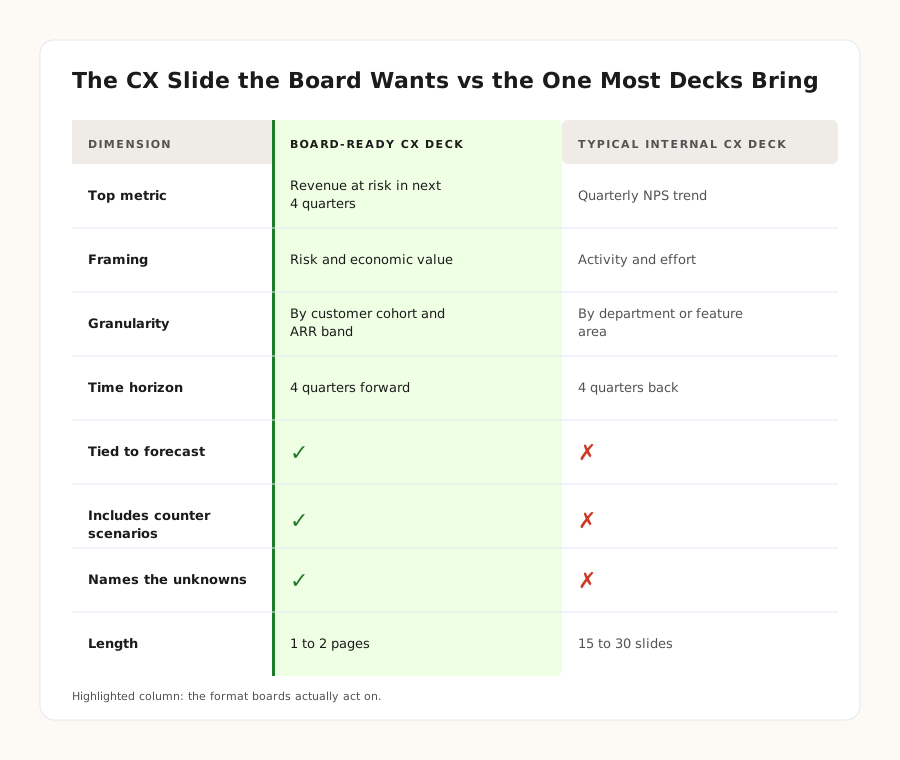
The board does not want to see your NPS. The board wants to know which experience risks are priced into the forecast and which are not. Most CX strategy decks fail this test because they confuse activity (workshops run, designers hired, surveys fielded) for risk (revenue at stake, retention exposure, deals lost in diligence). A UX board advisory engagement exists to close that gap. Done well, it produces a CX scorecard for board meetings that ties customer experience to dollars, a board-ready CX strategy that names the bets and the trade-offs, and a CX voice in the room that can defend the numbers when challenged.
Most CX decks fail the board because they confuse activity for risk
Spend ten minutes in any $5M to $50M ARR board pack and you will find the same CX slide. A line chart of NPS over four quarters. A bar chart of support ticket volume. A photograph of a customer interview. A roadmap of design improvements. None of it answers the question the board is actually asking, which is: how much revenue is at risk from the experience problems we know about, how much from the ones we have not yet measured, and what is your plan to convert that risk into retained or expanded ARR.
The framing matters because it determines what gets funded. A board that sees CX framed as activity will fund CX as a cost line. A board that sees CX framed as risk and revenue will fund CX as a strategic capability. The same company can get either treatment depending entirely on how the deck is built. I have watched founders walk into back-to-back board meetings and get diametrically opposite reactions to the same underlying CX program; the difference each time was language and structure, not effort.
PwC's 2025 Customer Experience Survey put it bluntly: CSAT and NPS are now vanity metrics in an era when companies need to track behavioral, emotional, and incremental impact. The survey's stronger argument is what comes next: loyalty needs metrics that link directly to enterprise value, including conversion rate attribution and customer lifetime value tracking. A board sees through scoreboards that don't connect to the P&L. They have been trained by financial reporting to ask one question of every metric: what does this number mean for the forecast.
The conventional rebuttal is that CX is leading-indicator work and you cannot tie every initiative to dollars in real time. That is true and also a dodge. The right response is to translate the lead indicators into bounded financial scenarios. If 30% of new accounts fail to activate within 14 days, and the median LTV of an activated account is $42K, the activation failure represents a knowable revenue exposure for the cohort. The board does not need a guarantee. The board needs a framework that converts CX state into financial state, with assumptions stated openly. That is a board-ready CX strategy. Anything else is theatre.
What a CX scorecard for a board meeting actually contains
A CX scorecard for a board meeting is a single page (or one page plus an appendix) that translates customer experience state into financial language the board already speaks. The scorecard answers four questions on its face: what is the experience health of the customer base, what dollars are at risk, where is the leadership investing, and what would the board need to see to know it is working. Anything beyond those four answers belongs in the appendix or in a follow-up working session.
A real scorecard contains five elements. Customer-experience health by cohort. Activation rate, time-to-value, and 90-day retention by cohort, segmented by ARR band or use case, not by feature. Boards do not care that the new dashboard shipped; they care whether the cohort that started 90 days ago is on track. Revenue at risk. A bounded number for the ARR exposed to each named experience problem (activation failure, support-heavy accounts, demo-stage friction in enterprise deals). The number can be a range; what matters is that it is grounded. Highest-impact bets. No more than three priorities for the next two quarters, each tied to a measurable outcome and a budget line. Leading indicators. The metrics the board should see between meetings to know the bets are tracking. Open risks. What is not yet measured and what would change the picture if it were.
That five-element structure is also the structure that survives investor diligence, which is not a coincidence. Sophisticated investors and sophisticated boards ask the same questions. The lazy version of a CX scorecard contains five charts. The board-ready version contains five answers.
McKinsey's research on operating models for customer experience supports this strongly. Their analysis argues that a CX center of excellence should report to a board member to ensure sufficient authority from the top, and that CX as a capability requires an operating model that defines roles up to the board level. The operational implication for a $5M to $50M ARR company is that the scorecard is not a slide for the board; it is the artefact that anchors the company's CX governance, with the board view being the most condensed version of it.
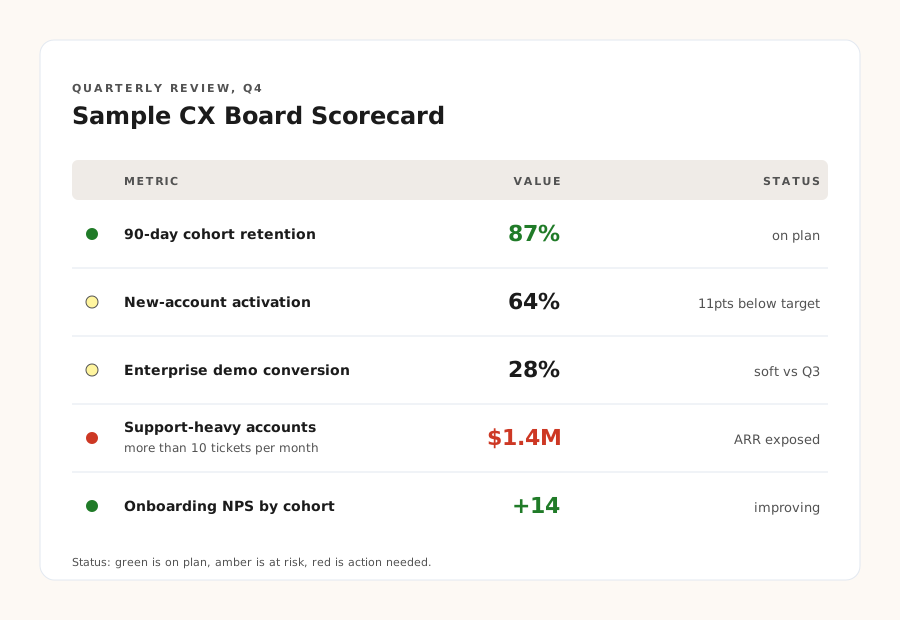
The scorecard above is illustrative; real ones differ by company. The point is the structure: states with colour codes, one number per row, dollars where dollars are knowable, and a clear distinction between things on plan, things at risk, and things bleeding. A founder can walk into the board meeting and run this in three minutes. The remaining 27 minutes go to the conversations that actually matter.
The board-ready CX strategy is structured around four questions
The scorecard is the artefact. The strategy behind it answers four questions, in this order. Skip any one of them and the deck stops being board-ready.
Where is the experience hurting revenue today. Not where users are unhappy. Where unhappiness is converting into churn, expansion failure, or won-but-failing deals. The cleanest version of this question names accounts and dollars. "$1.4M ARR sits with accounts averaging more than ten support tickets per month and below 30% feature adoption" is a board-ready statement. "Support burden is a concern" is not.
What experience improvements would produce the most retained or expanded revenue in the next four quarters. This is the prioritisation step, and it is where most internal CX strategies fail. Founders default to listing improvements without ranking them by revenue impact, often because the team has been trained to think in user-impact rather than business-impact terms. Both views matter, and the board only sees the second.
What does the operating model need to look like to deliver those improvements. A redesign without an owner is not a strategy. The board needs to know who is accountable, how decisions are made, and where the cross-functional handoffs sit. McKinsey's research finds that the highest-performing organisations have a chief customer officer or executive sponsor and an executive champion for each cross-functional customer journey. At $5M to $50M ARR you may not yet have a chief customer officer, but the principle holds: every named CX bet has a named executive owner.
What would tell the board it is working. The leading indicators between meetings. Not vanity metrics. Specific, instrumented signals that the bets are tracking. If activation is the bet, the indicator is activation rate by weekly cohort, not NPS. If enterprise demo conversion is the bet, the indicator is win rate at the technical-evaluation stage of the sales process, not deal velocity overall.
The four questions function as a forcing structure. They prevent the strategy from becoming a list of design and research initiatives without economic grounding. They also map naturally to how investors evaluate the same business in diligence, which is the next reason this matters.
The board does not need a guarantee. The board needs a framework that converts CX state into financial state, with assumptions stated openly. Anything else is theatre.
What investor diligence asks that internal CX decks never answer
Investor diligence is the stress-test that exposes whether a CX strategy is real. The questions a sharp diligence partner asks are not the questions an internal CX deck is built to answer; that mismatch is the moment most founders realise the deck is the problem.
The questions that come up consistently in product and CX diligence:
- What share of your churn is experience-driven versus product-fit driven versus pricing-driven, and how do you know. The answer requires segmenting churned accounts by behavioural data, support volume, workflow drop-offs, and stated reason. Without that segmentation, the founder cannot defend the retention forecast.
- What is your activation rate by cohort, and what is the relationship between activation depth and 12-month retention. This is one of the hardest questions to answer well. It requires that user research and product analytics be wired together, with a clear definition of activation that has held stable across cohorts.
- Which UX problems are gating enterprise deals at the demo or pilot stage, and what is the dollar value of those deals. Sales teams know the answer to this. CX teams often do not. The board-ready CX strategy connects them.
- Where is your support burden coming from, by cohort and by feature, and what is the cost-to-serve per dollar of ARR. Support is the most reliable proxy for unmeasured UX problems; its cost is also a board-readable number.
- What is the operational owner for customer experience, and how does that role escalate to the board. This is the governance question. Diligence partners want to know that experience is not orphaned in the org chart.
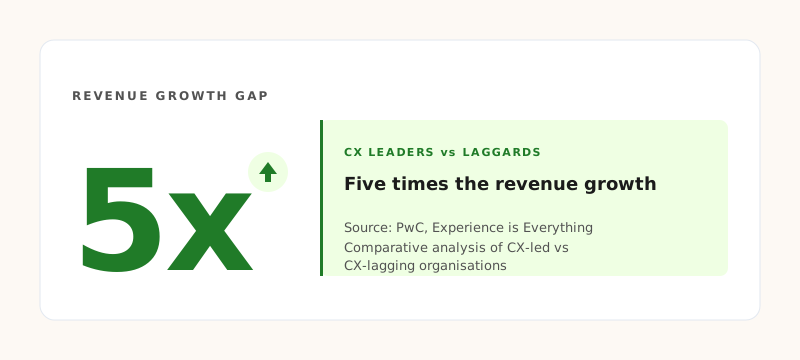
PwC's research adds an economic frame to all of this. Their CX analysis found that 48% of executives are increasing spend on customer experience, and CX leaders see five times the revenue growth of laggards. For a board or investor, the question is not whether to invest in CX. The question is whether the CX investment is being made against a strategy that will produce that growth differential, or against a list of activities that will not.
The retention economics support the same point. Bain's foundational research, popularised through HBR, finds that increasing customer retention by 5% can produce a 25% to 95% increase in profit, depending on sector. And High Alpha's 2024 SaaS Benchmarks report shows median public-software net revenue retention sitting around 110%, with companies sustaining 120%+ NRR commanding meaningfully higher revenue multiples in market. These are not abstract numbers; they are the reasons CX gets a board seat.
What good UX board advisory looks like, and what to look for in an advisor
A UX board advisory engagement is structurally different from a UX consultancy engagement, even when the underlying work overlaps. The advisory work happens at the board level: building the CX scorecard, drafting the board-ready CX strategy, attending the board meeting, defending the numbers under questioning, and helping the founder respond to investor diligence when it arrives. The deliverable is not a Figma file; it is a position the founder can hold in front of the board with confidence.
Two roles get confused with this work and should not be. A senior UX designer or design leader is responsible for design execution: experience design across the product, the design and research process, the design team that ships. That is design leadership, not board advisory. A UX manager runs the day-to-day of the design group: design direction, design practice standards, sprint cadence, hiring junior designers. Also not board advisory. A research lead or senior UX researcher running a research team focused on user research, user experience research, and qualitative work to validate user needs and end users' jobs is doing user-experience research, not board advisory. The skills overlap; the engagements do not.
What a UX board advisor does that those other roles do not: translate experience state into board language, anchor the CX scorecard in business metrics, attend the meeting where the board makes funding decisions, and provide guidance to the founder on how the strategy holds up against investor diligence. It is closer to fractional executive advisory than to UX consultancy, even though the foundation is product experience strategy and customer experience expertise.
What to look for in an advisor:
Operator background, not just consultant background. Someone who has been inside a $5M to $50M ARR company at the executive table, has presented to a real board, has answered diligence questions under pressure, and knows the difference between an internal CX review and a board-grade artefact. A typical profile: a decade of experience or two decades of industry experience across SaaS, B2B platforms, and consumer products, with at least one tour as a senior UX leader (head of design, head of UX, design director, or design strategist) inside an operating company. Some advisors carry 15 years of experience or 2 decades of work spanning product designer roles, design management, and senior practitioner ranks before stepping into advisory work full-time.
Board literacy. The advisor needs to read board decks fluently and speak board language. They have likely spent time as a founding member of a CX function inside a previous company, or as a fractional advisor who serves on the board or on an advisory board for several portfolio companies. They have seen how investors actually evaluate CX maturity in product diligence, and they know how board members in the room actually weigh UX and CX evidence against the rest of the operating picture.
Genuine experience-design depth. Underneath the board-level posture, the advisor needs to know the craft. Information architecture, usability testing, qualitative user research, interaction design, ux design fundamentals, design thinking as a working method, and product design at a working level. Not figma virtuosity (any good designer has that) but the ability to evaluate whether the team's design process and design practice will actually produce the improvements being promised. The strongest advisors operate from a human-centered design tradition rather than a feature-factory tradition: they think in terms of human-centered research, centered design as a discipline, and the broader UX practitioners' community of practice. Some advisors come from a design education that includes a master's degree in human factors, formal training in psychology from the university level, or HCI; others come from industrial design, interactive design, or industry professionals' associations such as a UX professionals association where they have served as a founding member or board member. The credential matters less than the demonstrated depth.
Cross-functional posture. A design-led mindset, but with the ability to work across product development, engineering, sales, customer success, and support. The advisor should be a forward-thinking innovator on user experience, but also a collaborator who can connect with the chief financial officer's view of cost-to-serve and the head of sales' view of demo-stage conversion. The work crosses into business innovation and operating-model questions, not just UI design.
Track record across stages. A founding member or design leader background at one or more high-stakes companies, ideally including some Fortune 500 companies and some scrappy growth-stage startups. The mix matters: the Fortune 500 experience teaches you how to read a board, the startup experience teaches you how to do it on a Series A budget. Some advisors come from a background of social impact work and B2B SaaS in equal measure, which broadens the lens.
The work of an advisory committee or advisory board for a CX-focused engagement looks different from a typical UX consultancy advisory committee. The deliverables are different. The cadence is different. The accountability is to the founder and the board, not to the design team. When evaluating an advisor, ask for two reference calls with founders who have used the advisor through a real board cycle or a real diligence event, and ask those founders specifically what got into the deck, what got cut, and what survived board questioning.
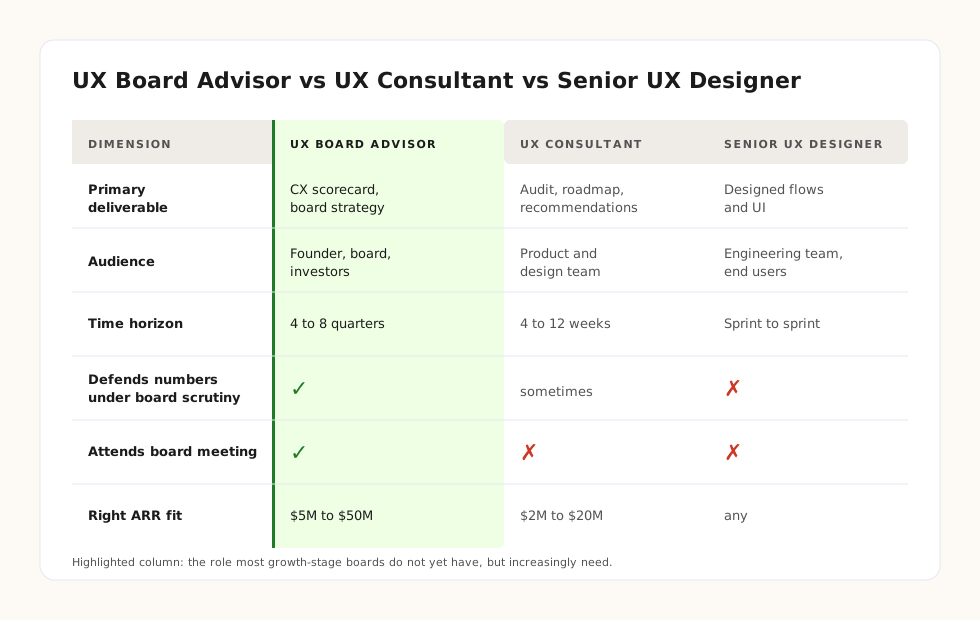
Three different jobs. Three different price points. Three different shapes of engagement. The mistake founders make is hiring a UX consultant when the binding constraint is board readiness, then being surprised when the consultant produces a 60-page report rather than a one-page scorecard. The work to drive business outcomes from CX requires a different posture than the work to drive design outcomes from a sprint.
If you are a founder at $5M to $50M ARR walking into a board meeting where CX or product experience will be on the agenda, treat the deck as a board document, not a UX document. Translate everything into the language the board already speaks. Lead with revenue at risk. Show the operating model. Name the bets. Identify the leading indicators. Acknowledge the unknowns. Reserve the appendix for the design and research detail.
If you are a founder heading into investor diligence, build the same artefact, because diligence partners ask the same questions in a different vocabulary. The CX strategy that holds up in front of the board will hold up in front of an investor. The CX strategy that does not will not.
Where the work is genuinely board-level (governance, scorecard design, attending the meeting, defending the numbers), bring in a UX board advisor whose background is operator-first and whose track record includes real board cycles. Where the work is design-team execution, hire a senior UX designer or design leader. Where the work is product-experience diagnosis at the team level, run a product experience audit. The roles are not interchangeable, and the price of treating them as interchangeable is the meeting where the deck does not survive the first question.
The board does not need more design vocabulary. The board needs a CX strategy that has been written in the language they already use. Build that, and CX gets funded as the strategic capability it is, not as the cost line it has too often been mistaken for.
Anton Stout
Author of the UXDesigned books and skills, with sixteen years in product design and research. About Anton