What Is Product Experience Strategy? A Founder-Level Framework
Product experience strategy is the executive-level plan that turns a SaaS product into compounding revenue. Here is the framework for building one.

Product Experience (PX) strategy is the executive-level plan that decides how your product creates value for a specific customer, in what sequence, and at what cost; everything else (the roadmap, the design system, the onboarding flow, the activation metric) is downstream of that decision. Most growth-stage companies do not have one. They have a product strategy, which is about what to build, and a feature backlog, which is about what to ship next. The connective tissue between those two things, the part that decides whether the product actually feels coherent to the person paying for it, is usually missing.
This article is for founders, CPOs, and product leaders running growth-stage companies in eCommerce, healthtech, education, FinTech, and adjacent categories who can sense the gap and want a working definition of what fills it.
A Working Definition of Product Experience Strategy
A product experience strategy defines the smallest possible set of choices about how your product will be experienced; choices specific enough to be wrong, and important enough that getting them wrong shows up in retention, expansion, or sales-cycle length.
In practice, four choices matter:
The promise the product makes to a target customer, narrowed to a single sentence that survives contact with the buyer. The sequence in which the product delivers on that promise, from first session to renewal or repeat purchase. The operating choices, design system, content model, telemetry, support model, that make the sequence repeatable. The measurement system that tells you whether the sequence is working.
That is it. A product experience strategy is not a 60-page deck. It is the four answers above, written down clearly enough that a new product designer joining on Monday could read them and know what to optimise.
The reason this matters now: as digital distribution shifts toward product-led and self-serve motions, the user journey defines not just how a product gets used but how it gets bought. When the product is the sales pitch (true for most eCommerce checkouts, telehealth onboardings, EdTech enrolments, and digital banking flows), the experience is the strategy. There is no longer a clean line between "what we sell" and "how it feels to use."
Why Product Experience Strategy Is Different From Product Strategy
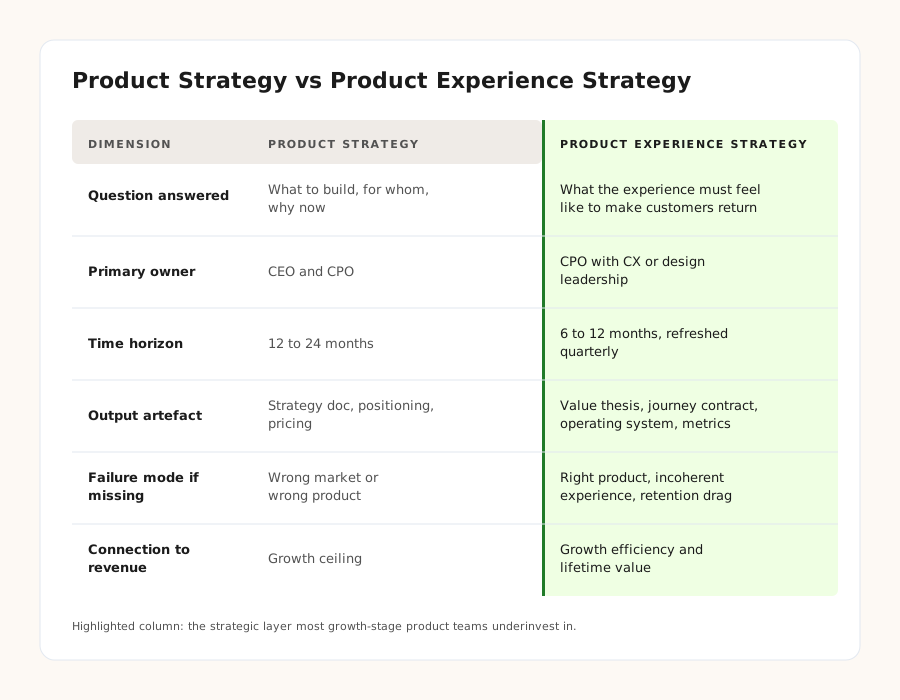
A product development strategy answers the question: if we build a product, what should we build, for whom, and why now. A product experience strategy answers a narrower question: given what we are building, what is the shape of the experience that will make a specific customer come back, spend more, and tell others.
Treat product strategy as the destination and product experience strategy as the route. The destination can be correct and the route still wrong. You can pick the right vertical, the right buyer, the right pricing model, and still ship a product that has grown by accretion: a stitched-together product where each new feature was a reasonable local decision and the cumulative result is incoherent.
That is the failure mode product strategy alone cannot prevent. Conventional product strategy frameworks, the standard product strategy framework taught in most product management programs, focus heavily on positioning, market sizing, and prioritisation. They are good at deciding which mountain to climb. They are quiet on what the climb feels like. Product experience strategy fills that silence.
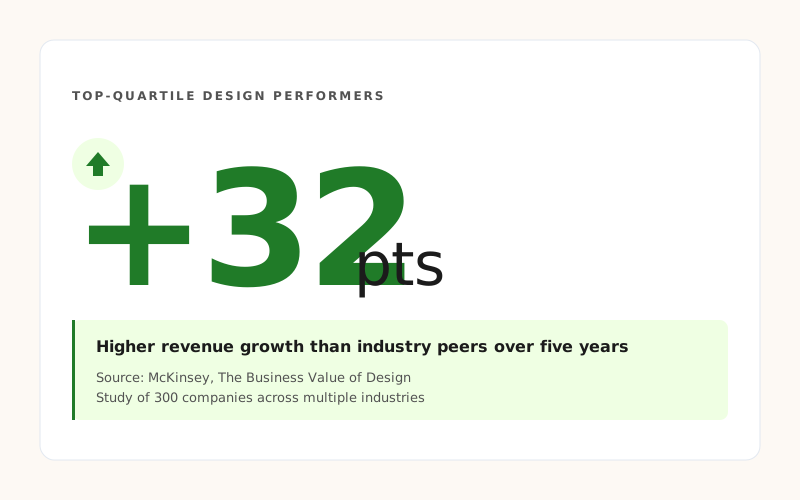
The economic argument for taking it seriously is well established and category-agnostic. McKinsey's Business Value of Design study, which tracked 300 publicly listed companies over five years, found that top-quartile design performers grew revenue 32 percentage points faster than industry peers and delivered 56 points more total return to shareholders. The pattern held across the three industries McKinsey studied: medical technology, consumer goods, and retail banking. Different products, same effect. Forrester's parallel research on customer experience leaders has reached similar conclusions across financial services, healthcare, and retail.
The Four Layers of a Product Experience Strategy
A useful product experience strategy stacks four layers. They are sequential, in the sense that getting the lower ones wrong corrupts the upper ones; you cannot build a coherent journey on a confused value thesis.
Layer 1, the value thesis
The value thesis is one sentence. It names the target user, the job they hire your product for, and the moment of value within the product.
For an eCommerce brand: "Active women aged 28 to 45 in Australia and the UK hire us to replace three or four pieces of their workwear rotation a year, and they feel that value the first time a parcel arrives that fits without alteration."
For a telehealth platform: "Time-poor parents hire us to resolve a non-urgent prescription concern without taking a day off, and they feel that value the first time a consultation closes inside a 30-minute window."
For an EdTech course platform: "Mid-career professionals hire us to make a specific career move within 6 months, and they feel that value the first time they finish a module and apply it the same week."
That sentence does work. It rules things in and it rules things out.
Most teams skip this step or fudge it. They write a value thesis that is really a positioning statement, broad enough to fit on a homepage and vague enough to please everyone in the room. A value thesis should be specific enough to make some people in the company uncomfortable. If your CTO does not flinch slightly at the constraint, it is probably too loose.
Sharpening the value thesis is the highest-leverage thing a founder can do for the product experience. A successful product strategy that aligns the value thesis to a specific customer needs answers a question that should not be hard but usually is: when this customer is using our product well, what does that look like?
Layer 2, the journey contract
The journey contract is the implicit promise the product makes about the order of value. It says: first you will feel X, then Y, then Z, in that order, and we will not let you skip a step that matters.
Think of it as the choreography between what the product expects of the user and what the user gets in return. A user signs up or lands on a product detail page; what is the smallest unit of value they should feel before they are asked to do anything taxing? They reach activation, the first purchase, the first completed lesson, the first booked consultation; what is the next earned moment of value? They invite a teammate, refer a friend, leave a review; how does the product reward that and create a habit?
This is where most stitched-together products break down. Each feature was added by a competent product team for a sensible reason, but no one was ever responsible for the order. The collective product feels jumpy. Users hit advanced configuration before they hit core value. Power features sit two clicks above empty states. Checkout asks for shipping country before it shows whether the item is in stock. The minimum viable product shipped clean and the next twelve months added to it without a connecting argument.
A clear journey contract is what an effective product strategy actually looks like at the product experience level. It is also the artefact a product manager should be able to point to when prioritising the backlog. Reforge's framing of product-led growth treats acquisition, activation, engagement, and monetisation as a connected loop, not a tactic bolted on to an existing product; the journey contract is the document that makes that loop legible.
Layer 3, the operating system
The operating system is the unglamorous infrastructure that makes the journey contract repeatable: the design system, the content model, the telemetry, the support playbook, the data management approach for product analytics and user behaviour. None of this is interesting in isolation. All of it is necessary.
This is where the importance of product investment becomes legible to a CFO. A consistent design system reduces engineering rework. A content model that scales with feature complexity reduces the support burden. Telemetry wired into the journey contract from day one means the product team can answer the question "is the experience working" without a six-week analytics project.
Growth-stage companies routinely under-invest here, partly because the work does not photograph well in a board deck. They pay for it later, usually in the form of a 60-page UX audit telling them what they already suspected.
Layer 4, the measurement loop
The measurement loop is the small set of metrics that tell you whether the strategy is working at the customer level, plus the cadence at which a leadership group reviews them.
Pick fewer metrics than you think. The exact metrics depend on the business model. For a transactional product, time-to-first-purchase, repeat purchase rate at 90 days, and basket-completion rate sit at the centre. For a subscription product, time-to-first-value, activation rate at a defined milestone, and net revenue retention by cohort sit at the centre. For an outcome-based product (telehealth, online learning), completion rate, outcome rate, and the time between first session and stated outcome matter most. The principle is constant: five numbers, reviewed at a cadence by people who can change the roadmap.
NPS is not on any of these lists, deliberately. NPS is a satisfaction indicator, not a strategy proxy; teams that run their experience by NPS end up optimising for the survey instead of the product.
How Do You Create a Product Experience Roadmap?
A product experience roadmap is not a feature list with experience words sprinkled on top. It is a sequenced plan for closing the gap between the journey contract you wrote and the experience you actually have.
The build sequence I recommend is short. Start by mapping the current product against the four layers above, ruthlessly. Where is the value thesis vague. Where does the journey contract get violated. Where is the operating system held together with one designer's heroics. Where is the measurement loop missing.
Then sort the gaps by revenue impact, not by user count. A friction point that affects 200 trial users a month is interesting; a friction point that affects 12 high-value customers a quarter, each worth $80K in lifetime revenue, is the work. Prioritise the moments that touch the customers who pay you the most or are about to.
Finally, sequence the work in 90-day blocks tied to a measurement loop. Each block has one or two experience changes, an analytics instrumentation requirement, and a defined success metric pulled from Layer 4. If a block does not have all three, it is not a block; it is a wishlist item.
A product experience roadmap built this way usually has a 6 to 12 month horizon and gets refreshed quarterly. Anything longer than that is fiction. Markets move; customer pain moves; the AI feature your competitor shipped last week moves the bar. A strategy that ensures your product remains aligned with your company's goals has to be reviewed often enough to stay honest.

How Do You Know If Your Product Has UX Debt?
UX debt is the cumulative cost of every experience decision that was rational at the time and incoherent in aggregate. Spotting it is part diagnostic, part pattern recognition. Six signals show up reliably in growth-stage products.
Customer support volume that scales linearly with revenue. If your support team has to grow at the same rate as your customer base, the product is not absorbing complexity well. Healthy products absorb it.
Sales engineers, customer success managers, or onboarding specialists spending their time explaining the UI rather than the value. When the product team has built something that requires translation, the product experience is the bottleneck.
A growing list of internal workarounds. CS managers building Notion or Confluence docs to explain how to actually use the product. That document is the journey contract you should have shipped.
Activation rates that vary widely by acquisition channel. If your conversion is 12% from one channel and 4% from another, the difference is rarely about the channel; it is usually about which segment can self-navigate the experience and which cannot.
Feature adoption curves that flatten quickly. New product features ship to enthusiasm and then plateau within six weeks at a fraction of the user base. The features are fine; the journey contract did not earn the user the right to find them.
A team that argues about priorities by anecdote. When the loudest voice in the room (or the loudest customer in the CRM) sets the roadmap, the underlying problem is the absence of a measurement loop. Strategy disappears and politics fills the vacuum.

Anton Stout
Author of the UXDesigned books and skills, with sixteen years in product design and research. About Anton