Fractional UX Designer vs UX Agency vs Fractional CXO: A Founder's Framework
The word fractional covers two very different jobs. Here is how to choose between a fractional designer, an agency and a fractional CXO.


If you're searching for a fractional User Experience designer, the term itself is probably misleading you. Most founders typing it into Google are picturing a senior individual contributor on Figma two days a week. That role exists. It is rarely the highest-leverage version of fractional UX for a B2B SaaS company at $5 - 25M ARR. The bigger question is whether the gap in your business is execution craft, leadership, or executive-level customer experience strategy. Get that wrong and you'll buy the wrong seat, watch your churn keep climbing, and conclude UX doesn't drive revenue.
This is a decision framework, not a vendor list. By the end you should know which of four options to engage, which to avoid, and what each one trades off against the others.
The search term is misleading you
The phrase fractional designer compresses two very different things into one keyword. The first is a senior product designer who designs, part-time, for a single company or two. The second is an experienced UX leader operating at a fraction of full-time capacity; hiring designers, setting standards, building the research function, owning the bar. The market uses one term for both because there isn't a cleaner shorthand yet. Most articles you'll read on this topic conflate them.
The conflation matters because the two solve different problems. The senior IC version is execution help. The leadership version is the seat above execution that decides what the IC should be working on, what the design system should look like, who the next hire should be, and how the team measures whether design is producing business outcomes. Both are legitimate. Hiring the wrong one is how companies end up with a beautifully designed product and the same retention curve.
I'll walk through both and the two adjacent options most founders end up choosing instead, so you can match the seat to the gap.
There are three tiers of fractional UX, not one
Three distinct seats sit under the fractional UX label, plus a fourth option (an agency) that operates outside the model entirely. Treat them as a tier, with cost and leverage rising as you move up.
Tier 1: fractional UX designer: The senior IC version
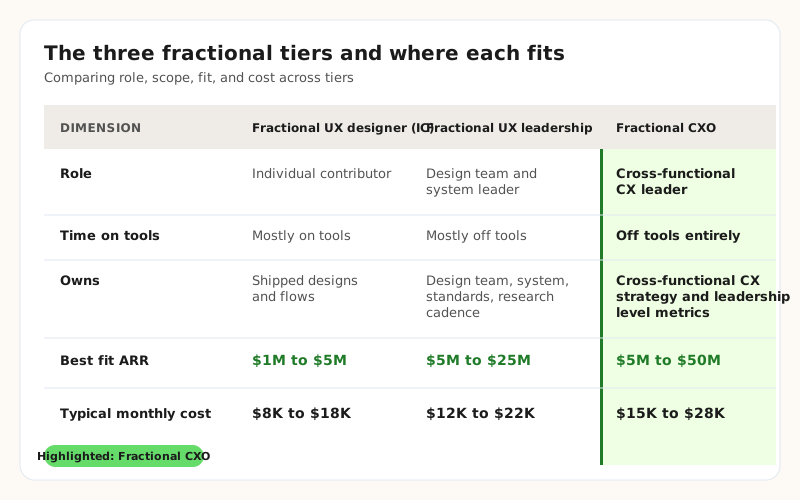
This is the version most founders picture when they search the head term. A senior product designer, two or three days a week, embedded enough to know your product but not on payroll. They're on the tools: user research, interviews with five to eight customers per cycle, journey mapping, wireframes, high-fidelity mocks, prototype, handoff to engineering, user testing on what shipped. A good fractional product designer covers UX and UI; a great one will push back on the brief.
When this version fits: you have product managers writing reasonable specs, an engineering team that can ship what's designed, and a clear backlog of UX improvements where the prioritisation is obvious. The fractional UX designer plugs in, raises the craft floor, and turns what your engineers were drafting in Figma into something that respects your users. Highest-leverage at $1 - 5M ARR, where the company or startup has product-market fit but inconsistent UX.
When this version breaks: the brief itself is wrong. If three product managers each have a different theory of who the user is, no amount of design execution closes that gap. If your CEO and your VP Product disagree on whether next quarter is about activation or expansion, no IC designer is going to resolve that disagreement at the design review. The IC version assumes someone above them has answered those questions.
Tier 2: fractional UX leadership: Off the tools
This is where most $5 - 25M ARR B2B SaaS companies create the most value, and it's the version least well-understood by the market. A fractional UX leader is not designing screens. They are setting the bar that the team's designs are measured against.
The work looks like this:
- Hiring and vetting designers: full-time, contract, or fractional product designer hires that match your product and stage
- Running the research cadence: listening posts, customer interview programmes, usability studies, the systems that keep user insights flowing into the team
- Building the design system as a piece of product development and infrastructure rather than a Figma library
- Setting standards for what good looks like, then holding the team to them at design review
- Stakeholder management upward to founders and the executive team, and outward to product, engineering, and customer success
- Defining the metrics that tell you whether design is producing business outcomes: activation, time-to-value, support volume, expansion
If your company has two or three designers and no senior design leadership, this is almost certainly the seat you need. The team's individual skills and experience aren't the problem; the absence of someone who knows how to point the team at the right work is. NN/g's UX maturity research identifies strategy UX leadership, planning, and resource prioritisation as one of four factors that determine whether design produces business value Nielsen Norman Group. A fractional UX designer at the IC level cannot fill the strategy seat. A fractional UX leader can.
This is also the seat that most directly reduces ux debt over time, because the person in it owns the design system, the review process, and the hire-vs-promote decisions that compound into either a coherent product or an inconsistent one.
The IC fractional UX designer increases the volume on the customers voice in your product decisions. The fractional UX leader raises that volume and the strategic ceiling.
Tier 3: fractional CXO: The executive seat
A fractional CXO is a senior executive who sits at the leadership table part-time, usually one to one-and-a-half days a week. The role is upstream of design entirely: it owns customer experience strategy across product, design, engineering, customer success, and marketing. The fractional CXO joins your leadership meetings, contributes to roadmap prioritisation, sets the metrics that govern customer experience, and represents the user when the conversation drifts into feature politics or sales-led roadmap pressure.
To answer the question directly: a fractional CXO is a senior executive who works part-time with a company to lead customer and product experience strategy. They align teams around user outcomes, prioritise improvements tied to retention and conversion, and provide leadership input across the decisions that touch the customer. They don't draw screens, they don't open Figma, and they don't run the design team day-to-day. If they're spending their time in design files, you've miscast the role - what you actually wanted was a fractional UX leader.
The trigger for hiring a fractional CXO is rarely "we need better designs." It's one of these:
- A board member asked a question about CX strategy that the founder couldn't answer
- Net revenue retention is below 100% and the customer success function can't explain why
- The product is shipping features quickly and customer satisfaction is dropping
- An enterprise prospect raised a concern about UX maturity during diligence
- The company is between heads of product or design and needs leadership cover for six to nine months
McKinsey's analysis of 40 public B2B SaaS companies found that those with net revenue retention of 120% or more traded at a median EV/revenue multiple of 21-fold compared with ninefold for those below the 120 percent mark McKinsey & Company. The differential is enormous, and it sits downstream of decisions made at the leadership table - not at the design review.
Fractional CXO vs full-time CXO: which is better? Fractional is better when you need senior strategic input fast, want to lower the cost and risk of a wrong hire, and don't yet have enough ongoing executive work to justify a permanent seat. Full-time is better once experience leadership is required across hundreds of decisions a quarter and across multiple product lines.
Do you need a fractional head of design or a fractional CXO? A fractional head of design (Tier 2) when the gap is design-team leadership, designers who need a manager, mentor, and standard-setter. A fractional CXO (Tier 3) when the bigger gap is cross-functional CX strategy across product, design, engineering, and customer success.
Why a UX agency rarely fits a $5 - 25M ARR business
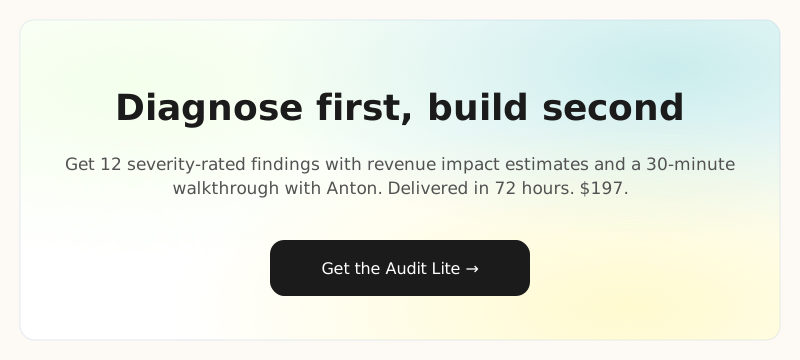
A UX agency is a different animal. Projects, not retainers. Six to sixteen weeks, fixed scope, fixed fee, $40K to $200K. They show up with a team of three to six; strategist, lead designer, junior designer, researcher, sometimes a product manager; own the design process from kickoff through prototype and delivery, then leave. For some companies this is the right model: a discrete product launch, a regulated compliance redesign, a brand-and-product overhaul where you need senior craft for a defined window and don't want to manage the talent. A good agency or design partner is genuinely useful in those cases.
For most B2B SaaS at $5M to $25M ARR, the agency model misfires for three reasons.
The first is incentive. Agencies are built around big deliverables: research reports, persona decks, journey maps, 60-page strategy documents. Those artefacts justify the bill, but most of them get read once and shelved. Your team needed three sharp insights and a sequenced fix list; you got 60 pages.
The second is continuity. The deliverable is the end of the relationship. The best UX work in a SaaS product is not a project but a practice, continuous user research, iteration after release, reading the data three months in and learning what the design got wrong. Agencies don't do this well because their economic model doesn't reward it.
The third is what happens after the redesign. I've sat across from too many founders who paid an agency $80K, shipped most of it, and then watched the metrics not move. The agency had no skin in the post-launch game. The redesign looked great in the showcase. The trial-to-paid number stayed flat.
The exception worth naming: a focused UX audit from an agency, sized at four weeks and aimed at diagnosis rather than redesign, is genuinely useful. The bad agency engagement is the one that begins by skipping diagnosis and producing 200 screens of new designs.
How to choose the right tier
The simplest way to choose is to ask which of these questions you can't answer right now.
"How should this specific flow actually work?"
Onboarding keeps stalling, your engineers have made three attempts, the spec keeps changing. You have an execution-craft gap. Tier 1: a fractional UX designer at the IC level.
"Who decides what the team is working on, who do we hire next, and what does good look like for our product?"
You have designers but no design leadership, and the team is shipping inconsistently. You have a leadership gap inside the design function. Tier 2: fractional UX leadership.
"Which problem should we be solving first across the whole customer experience, and how do we measure whether it worked?"
The team is busy, the roadmap is full, the metrics aren't moving, and the CEO can't tell whether the next 90 days should be about activation, retention, or expansion. You have a strategy gap above the functions. Tier 3: a fractional CXO.
"We have a defined product launch in 12 weeks and we don't have the senior craft on staff to ship it."
The brief is sharp, the scope is fixed, you have someone internal who can hold an external team accountable. You have a project-capacity gap. UX agency.
A note on combinations. Tier 2 and Tier 3 paired together, fractional UX leadership owning the design function, fractional CXO owning cross-functional CX strategy, is a strong configuration for $10 - 25M ARR companies where both gaps are open. Tier 1 plus Tier 3 (an IC designer plus a CXO, no leadership in between) tends to fail because the CXO doesn't manage designers and the designer has no leader. Avoid running a UX agency project simultaneously with a fractional CXO engagement: the agency will produce strategy artefacts that compete with the CXO's prioritisation work. Pick one strategy seat.
The cost comparison founders usually get wrong
Most founders compare a fractional UX designer's monthly invoice to an agency's project fee and skip the full-time hire's true cost. The right comparison loads the numbers in equivalent terms.
A senior UX designer in the United States earns an average base salary of $180,216 per year, with the typical pay range between $140,801 and $234,505 Glassdoor. The fully loaded cost is higher: there's a rule of thumb that the cost is typically 1.25 to 1.4 times the salary SBA once payroll taxes, benefits, equipment, and overhead are added. A $180K base hire costs the company roughly $225 - 250K a year all-in. Add recruiting fees if you used an agency to find them typically 20 - 25% of first-year salary and the first-year cost lands closer to $260 - 290K. That's an IC, not a leader. Senior UX leadership full-time runs higher: $220 - 280K base, $275 - 390K loaded, $310 - 435K first-year with recruiting.
A full-time CXO or VP Product hire is higher again: $250K to $350K base plus equity, $315K to $490K loaded.
Now the fractional comparisons:
- Tier 1 fractional UX designer (IC):
$8K to $18K per month for two days a week, $96K to $216K annually. Saves money against the full-time IC equivalent, mainly through optionality you can change, expand, contract, or end the engagement without severance or performance management. - Tier 2 fractional UX leadership:
$12K to $22K per month for one-and-a-half to two days a week, $144K to $264K annually. Compared to a full-time UX leader at $310K to $435K all-in, you're at roughly half the cost for what is for most $5M to $25M ARR companies substantially more of the work that actually moves the needle on retention. - Tier 3 fractional CXO:
$15K to $28K per month for one to one-and-a-half days a week, $180K to $336K annually. Against a full-time CXO at $315K to $490K, the same arithmetic. More importantly, it's reversible you keep the option to hire full-time when the volume of executive work justifies it. - UX agency project:
$40K to $200K for 12 to 16 weeks, harder to compare because it's not ongoing. The same $80K split as a fractional UX designer retainer over six months gets you a designer embedded for half a year with continuity into iteration and post-launch learning. Agencies are useful when continuity isn't what you need; expensive when it is.
The benefits of hiring fractional talent show up most clearly on the downside. The cost of a wrong full-time hire, recruiting fees, salary during the wrong-fit period, severance, the opportunity cost of the role being unfilled while you re-recruit, is conservatively 1 - 1.5x base salary. For a senior UX leader that's $220 - 420K of risk on a single hire. Fractional roles carry near-zero downside risk: change the engagement and move on.
The fractional model also lets you bring in design expertise without the overhead of a full-time hire and without the long-term commitment of a permanent role. You get a proven track record at a fraction of the cost, and the hiring process collapses from three months to two weeks. For most companies the optionality is worth more than the cash saved.
The retention argument that makes the decision easy
I want to ground the whole comparison in the number that actually matters at the founder level. Retention. A 5% lift in customer retention can increase profits by 25% to 95% Harvard Business Review, per Reichheld's foundational work at Bain. Median public-SaaS net revenue retention currently sits at around 110% Growthunhinged per the 2024 SaaS Benchmarks Report from High Alpha and OpenView, with revenue growth at 17 - 18%. A move from 100% NRR to 115% NRR is, at the leadership level, the single largest lever you have over enterprise value.
Most experience-driven churn comes from one of three places: a broken activation moment in onboarding, a workflow that becomes painful at scale, or a feature that promised a job-to-be-done it doesn't deliver. The fix is a combination of diagnosis (which problem), execution (a sequence of UX improvements that ship), and leadership (someone who keeps the team focused on retention metrics rather than feature volume).
This is why I'm sceptical of the agency model for ongoing SaaS work, sceptical of a Tier 1 fractional UX designer when prioritisation is unclear, and bullish on the Tier 2 and Tier 3 seats for companies above $5M ARR where the leverage on retention is large.
McKinsey's Business Value of Design found that top-quartile MDI scorers increased their revenues and total returns to shareholders (TRS) substantially faster than their industry counterparts did over a five-year period Designinnovationglobal - 32% points higher revenue growth and 56 percentage points higher TRS growth. That gap is not produced by a redesign. It's produced by the four practices NN/g calls strategy, culture, process, and outcomes, leadership-level work. The same study reported that fewer than 5% of the surveyed companies reported that their top managers could make objective design decisions CNN. That's the gap the Tier 2 and Tier 3 seats are designed to fill.
Don't choose between a fractional UX designer, a UX agency, and a fractional CXO based on what they cost. Choose based on the question you can't answer.
If the gap is a single flow that won't come right, onboarding, settings, an enterprise workflow and the prioritisation upstream is clear, hire a Tier 1 fractional UX designer. The IC version of the model is the right tool when you know what to design and you need senior hands to design it well. You'll get user research, prototypes, and shipped UX improvements at a fraction of the cost of a full-time UX designer.
If you have designers but no senior design leadership, no one setting standards, no one running the research cadence, no one deciding which designer to hire next, no one accountable to the executive team for the bar, you have a leadership gap. Hire fractional UX leadership. This is the seat where most $5M to $25M ARR B2B SaaS companies create disproportionate value, and it's the version of fractional UX I'd argue is most under-bought relative to its leverage. The team you have is probably more capable than its current output suggests; what's missing is the person who points it at the right work.
If you can't tell me which problem to solve first across product, design, customer success, and engineering, or which metric you'd watch to know whether it worked, you don't have a design problem. You have a strategy problem. A fractional CXO is the right seat. The role exists because the leadership-level CX gap, the one that opens up when product, design, customer success, and engineering each have a partial view of the user, is structural at $5 - 50M ARR and not solvable with more execution capacity.
If you have a discrete, well-scoped project with a fixed window and you don't want to manage talent, a UX agency is the right call. Be ruthless about scope. Refuse the 60-page strategy deliverable. Treat the agency as execution capacity, never as your strategy seat.
The configuration I most often recommend at $10 - 25M ARR is fractional UX leadership inside the design function, paired with a fractional CXO at the leadership table. You get standards and craft from the first seat, prioritisation and cross-functional alignment from the second, and the optionality to convert either to full-time when the work justifies it. The combined cost lands below a single full-time VP Product hire, with materially lower hiring risk and faster time-to-value.
The wrong move is to assume the answer is design execution because design execution is the most visible part of the problem. Design execution is downstream of leadership. Fix the leadership gap first and the design work that follows will compound. Skip it and you'll have a prettier product and the same churn number twelve months from now.
Anton Stout
Author of the UXDesigned books and skills, with sixteen years in product design and research. About Anton