Fractional Head of Design vs Interim UX Leader: What Changes at $5M ARR
A fractional head of design is the right hire at $5M ARR when you need senior design leadership without the commitment of a full-time CDO.

The fractional head of design is the right hire at $5M ARR when the company needs senior design leadership without the commitment of a full-time chief design officer, and when the work is too strategic to delegate to an in-house IC. The wrong move at this stage is what most founders do: promote their best designer into the title and hope it works. It usually does not. The economics of a full-time design leader do not yet support the role. The economics of leaving the design function unled cost more than founders realise. A fractional design leader, scoped properly, is the bridge.
At $5M ARR the question is not part-time vs full-time, it is what work actually needs doing
The framing most founders bring to this decision is wrong. They start with "do we need a full-time head of design," conclude they cannot afford one, and then either delay the hire for two more years or promote a senior IC into a leadership position they were not prepared for. Both options are expensive. The right question is not whether to make the role full-time. It is what design work the company actually needs done in the next nine to twelve months, and which of those needs justify a senior leader.
At $5M ARR, the work that genuinely requires senior judgment is concentrated in a small number of decisions. Setting the design direction for the next twelve months. Hiring the next two to four designers. Establishing the design process the team will use. Putting design representation on the executive table where roadmap decisions get made. Translating user research into product decisions the engineering team can ship. Making sure the design team's specific needs (tooling, hiring pipeline, review cadence) get budgeted for.
That list runs to perhaps two days a week of senior leadership time. Not five. The reason fractional design leadership works at this stage is structural: the senior work of a design leader is concentrated, not distributed. The remaining three days of a full-time CDO's week is largely team management, design work review, and the kind of stakeholder meetings that grow with the size of the org. A 30-person company does not generate that workload. A 200-person company does.
The High Alpha 2025 SaaS Benchmarks report puts hard numbers behind this. SaaS companies in the $1M to $5M ARR band employ a median of 22 people, generating roughly $136K ARR per employee, with top-quartile firms reaching $200K per employee. A 22-person company that adds a $310K-loaded chief design officer absorbs roughly 10% of payroll into a single role whose job-to-be-done is genuinely part-time at this stage. That is not lean. That is mis-priced.
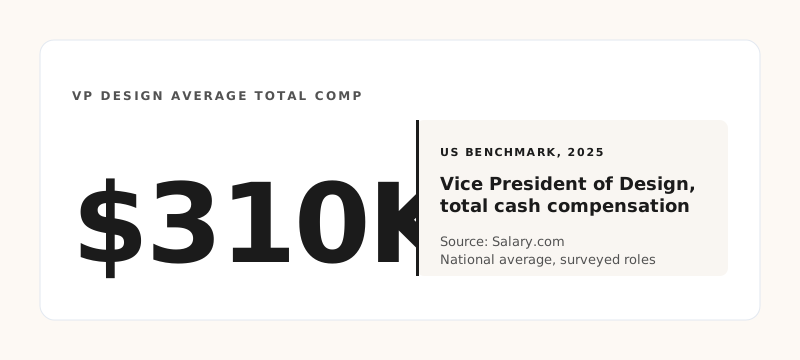
The salary band itself underscores the problem. Salary.com puts average US total cash compensation for a VP of Design at around $310K, with base salary typically $222K to $255K; Glassdoor reports a typical pay range of $217K to $382K, with 90th-percentile earners above $490K. The fully-loaded cost of a full-time hire (compensation, benefits, equity, recruiter fees, ramp time) at $5M ARR competes directly with three engineers or a Series A go-to-market hire. Given limited resources, founders have to ask whether the role earns its place against those alternatives. At $5M ARR, the honest answer is usually no, not yet.
A fractional head of design is a leadership position, not a senior IC contract
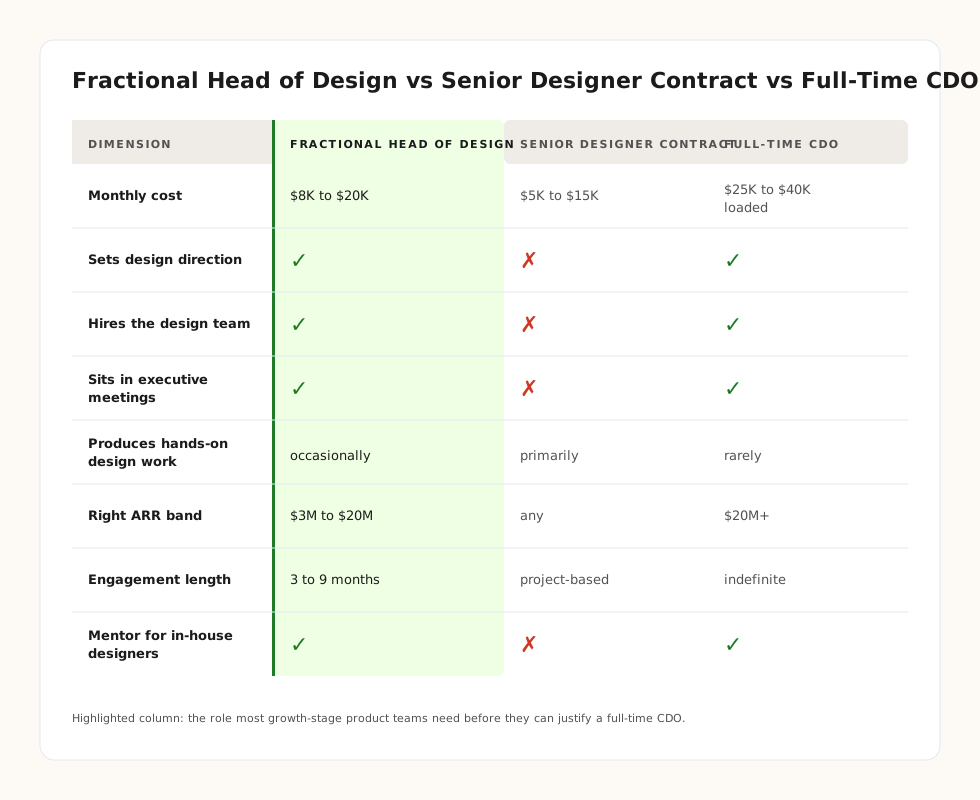
This is the part most founders get wrong. They confuse a fractional engagement with hiring a senior contractor to do design work part-time. Those are different things. A senior IC working part time will produce screens, prototypes, and the occasional figma file. They will not set design direction, hire designers, sit at the executive table, or be accountable for the design function across multiple product areas. A fractional design leader will.
The McKinsey research on this is the clearest framing I have seen. Their analysis of 200 senior design leaders identified five archetypes; the highest-performing roles are C-level executives with direct CEO sponsorship, while "functional heads" reporting into marketing or product are too often limited by their superiors' worldview and incentives. McKinsey's broader research found that some 90 percent of companies are not reaching the full potential of design, even as the number of senior design roles has roughly doubled in the past five years. The takeaway is not that you need a full-time CDO. The takeaway is that whoever holds design leadership has to actually be in the room where decisions get made.
A fractional engagement that does not put the design leader in the room is a contract for design work, not for design leadership. The distinction matters because the price is different and the outcome is different. A senior designer on a project basis at $200 to $300 per hour will produce a few weeks of design output. A fractional head of design at $8K to $20K per month will, over a six-month engagement, set the direction of the design function, hire the right people, and align the design team behind a product vision the founder can defend to the board.
The work breaks down into roughly four buckets:
Direction and strategy. The fractional design leader sets the next twelve months of design direction, aligns it with the company's broader strategy, and translates business objectives into design initiatives the team can actually ship. This is the part that most senior IC contracts skip. Done well, it ensures alignment between the design function, the engineering team, and the founder's product vision; done badly, it produces a deck nobody acts on.
Hiring and team building. Building a design team of three to six is one of the most consequential things a fractional leader does at this stage, and the place where their industry expertise pays back fastest. They write the job specs, run the interview loop, and make decisions about who to hire and at what level. The CEO does not have to spend 30% of their time on design recruiting. The fractional leader's track record of helping businesses build design teams from one to ten is, at this stage, more useful than any other single piece of design expertise.
Process and operations. A fractional design leader establishes the design process the team will use, the design system the product will run on, and the review cadence that keeps work moving without becoming a bottleneck. They also bring best practices from prior engagements rather than letting the team reinvent first principles. Where the team has accumulated workarounds and inconsistencies, the fractional leader acts as a facilitator who helps the team agree on common standards rather than imposing them top-down.
Executive representation. The fractional leader sits in the leadership meeting where roadmap decisions get made, and represents design at the C-suite level even though the engagement is fractional. This is where the McKinsey "executive archetype" actually shows up, and where strategic guidance to the CEO and the rest of the leadership team gets delivered. Without this, design ends up downstream of decisions it should have shaped.
If your prospective fractional engagement does not include all four of these, you have hired a senior IC, not a design leader.
Why promoting your best designer to head of UX usually fails
The conventional move at $5M ARR is to promote the best in-house designer into a head of UX or head of design title. The instinct is reasonable: they understand the product, they have the team's trust, the cost is incremental rather than additive. The problem is that the work of a design leader and the work of a senior designer are different jobs, and being excellent at the second does not predict being good at the first.
McKinsey's research makes the point more carefully. Junior designers tend to consider the depth of their design craft as the most important criterion for gaining seniority. Business and design executives identify leaders quite differently: those who can drive integration across functions. The gap is not technical. The gap is in the work itself. The senior IC has been trained for years to make the screens better. The leader's job is to make the team better, the strategy clearer, and the boundary with engineering and product cleaner. Those are not transferable skills overnight.
I have watched this play out at four different $5M to $15M ARR companies in the last three years. The pattern is the same. The newly-promoted lead spends their first three months trying to do both jobs (still designing flagship features, also running the team) and burns out. They spend the next three months trying to delegate the design work to the team that they have not yet built or trained, and the quality drops. By month nine, they have either left the company or asked to step back into an IC role. The startup is now nine months behind on building the design team it needed, and has lost a senior IC in the process.
The fix is not to never promote. The fix is to bring in fractional design leadership during the period when the in-house designer is being developed for the role. The fractional leader handles the strategic work, hires the team, sets up the process. The senior in-house designer (now reporting to the fractional leader) gets six to nine months of structured mentorship from someone whose job it is to develop them. At the end of the engagement, the senior designer is genuinely ready to step into the leadership position, with a team they helped build and a process they helped shape.
The fractional head of design becomes, in effect, a paid mentor for the eventual full-time leader. That is a far cheaper way to build design leadership than firing a senior designer twelve months later because the promotion did not work.
The senior IC has been trained to make the screens better. The leader's job is to make the team better. Those are not the same job, and being excellent at the second does not predict being good at the first.
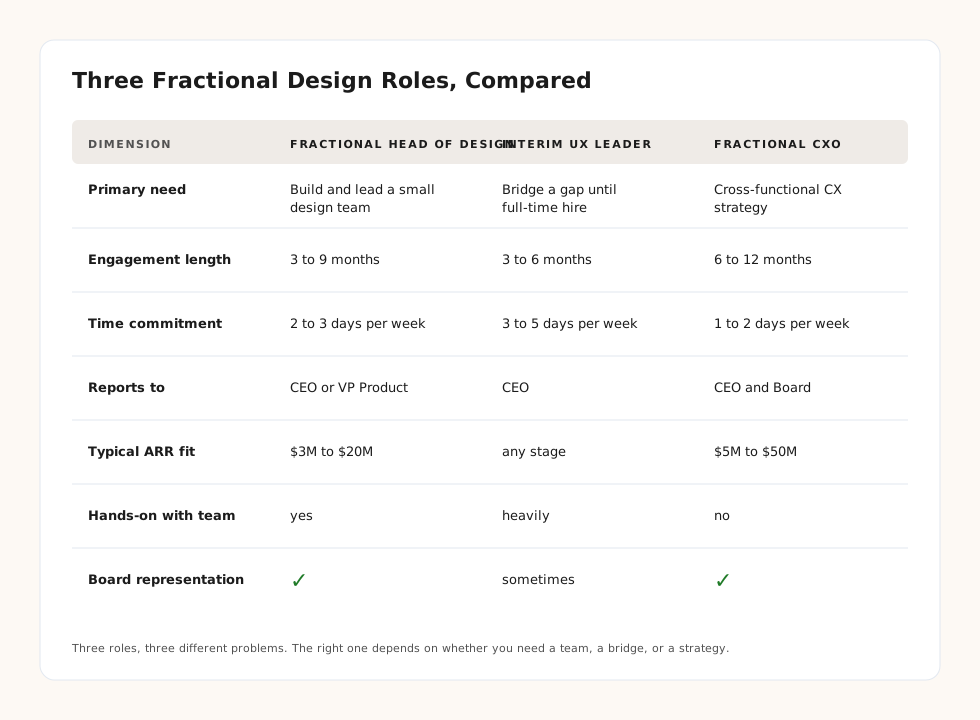
Fractional head of design vs interim UX leader vs fractional CXO
The terminology in this space is overloaded. Three roles get used almost interchangeably; they are not the same. The decision of which to hire follows from which problem is actually binding.
Fractional head of design. A part-time engagement (typically two to three days per month or per week, depending on scope) where a senior design leader takes responsibility for design direction, team building, and executive representation. The engagement is ongoing, usually three to nine months. This is the right shape when the company has a small but real design function (one to four designers) and needs leadership to grow it. Sometimes also called a virtual UX director or temporary UX director.
Interim head of UX (also: interim UX leader, embedded UX leader). A time-bound engagement, usually three to six months, where the leader is essentially a temporary CDO until a full-time replacement is hired. The interim leader is more hands-on with the team, sometimes near full-time during the engagement. The right shape when the company has just lost a design leader, is actively recruiting a replacement, and cannot leave the function unled in the meantime.
Fractional CXO (chief experience officer). A broader role spanning customer experience strategy across product, design, support, and sometimes marketing. Engagement is part-time, typically board-facing, focused on cross-functional alignment rather than design-team management. The right shape when the binding constraint is not design execution but the absence of a CX voice at the leadership table.
Three different jobs, three different price points, three different shapes of engagement. The mistake founders make is to scope the engagement before they have diagnosed the problem. Do that backwards and you end up with the wrong advisor in the role.
A useful diagnostic: ask which of these three sentences is closest to the truth in your company today. (1) "We have one or two designers and we need to build a real design team in the next nine months." (2) "Our head of design left and we have a search underway, but the team will fall apart without leadership in the meantime." (3) "Customer experience is fragmented across product, design, and support, and there is no executive owner pulling it together." Sentence one points to a fractional head of design, sentence two to an interim UX leader, sentence three to a fractional CXO. Get the diagnosis right and the role almost picks itself.
What good looks like, and how to scope the engagement
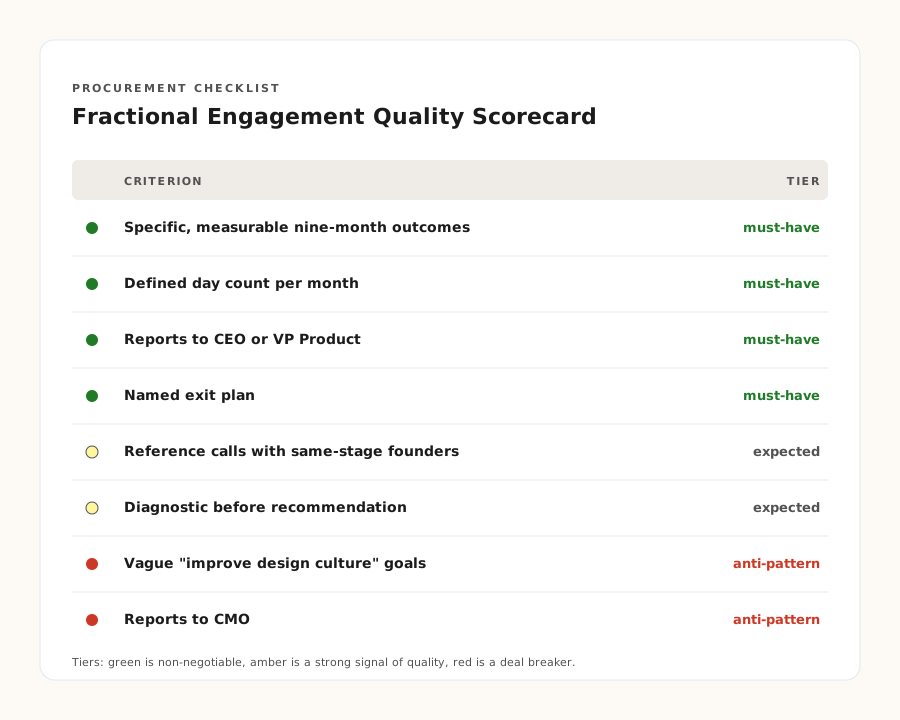
A fractional engagement that works does so because the scope was right at the start. The ones that fail almost always fail at the scoping stage, not the execution stage. The questions to answer before signing the contract:
Ask: what does success look like in nine months. The answer should be specific and measurable. A design team of four hired, a design system shipped, three flagship product flows redesigned, a CX dashboard live for the board. If the answer is "improved design quality" or "stronger design culture," the engagement has not been scoped. Vague success criteria produce vague engagements; specific tangible results, by contrast, give both sides something to measure against.
Ask: how much time per month. A fractional design leadership engagement is typically eight to twelve days per month, scoped explicitly so both sides know what is in and out. Less than eight days is rarely enough to drive design at the leadership level. More than twelve and you are usually paying for a full-time hire dressed in fractional clothing. Founders sometimes ask for the model that gets them senior leadership without the overhead of a full-time role; the answer is yes, and the price of that model is that the engagement has hard time boundaries that both sides respect.
Ask: who does the fractional leader report to, and who attends what meetings. The right answer puts the fractional leader in the leadership meeting where roadmap decisions get made, and reporting to either the CEO or the VP of Product. If the engagement is structured so the fractional leader reports to the CMO, McKinsey's research suggests they will be limited by the CMO's incentives, not yours.
Ask: what does the handoff look like at the end. A good fractional engagement has an exit plan from day one. Either the in-house senior designer is being developed to step into the role (with a named six-month mentorship arc) or the engagement is bridging to a full-time hire (with a named search timeline). An engagement that does not end is an engagement that is mis-priced, and an engagement that does not deliver a fully-functioning design organisation within your organization is one that has under-delivered against its scope.
Ask: what is the fractional leader's track record. The advisor's extensive experience matters less than their decade of experience operating at exactly your stage. A former Director of Design from a 5,000-person tech company is often a worse fit than a former founding designer who has scaled three different teams from one to ten. Ask for two reference calls with founders they have worked with at $3M to $20M ARR, and ask those founders specifically what got hired, what got shipped, and what got measured. Seasoned professionals who have done this work three or four times will have crisp answers; the ones who have not will give you abstractions.
The advisor should be doing the diagnostic work of understanding your business in the first two weeks. They should ask about your company's product, your roadmap, your team dynamics, your customer base, your business needs, your business goals, and your sustainable growth targets. If the advisor opens with their own framework before listening to yours, that is a flag. The good ones tailor their approach to your project requirements rather than handing you a templated playbook.
A real fractional head of design will turn down engagements that are not scoped right. That is the strongest signal of all. A seasoned advisor with a track record will not take an engagement where success is undefined, the access is limited, or the founder is unwilling to give them the executive seat the work requires. If you are interviewing fractional design leaders and none of them push back on your scope, you are interviewing the wrong people. The right people will work directly with you to redefine the engagement before they sign.
The fractional model is not new. CFO services have been fractional for two decades; CMO and CTO services for one. Design leadership is the latest C-suite role to be unbundled this way, and the unbundling makes economic sense at the same ARR band where fractional CFOs first did. Designer Fund's research with founders documents that the first design hire often grows into a head of design over time, but the gap between hiring the first designer and being ready for that promotion is exactly where fractional design leadership earns its place.
The reason this matters now more than five years ago is that the cost of getting design wrong is higher in a rapidly evolving business landscape where buyer expectations move faster than internal hiring cycles. McKinsey found that companies excelling at design grow revenues and shareholder returns at nearly twice the rate of their industry peers, yet only about 10% of companies are capturing that value. And on the retention side, Bain's Reichheld research found that a 5% increase in customer retention can produce a 25% to 95% increase in profit, depending on the sector. Design leadership at a $5M to $20M ARR company is one of the highest-impact roles a founder can fill. Hiring it badly costs you that impact. Hiring it not at all costs more.
The fractional model has continued to evolve as more senior leaders work this way by choice rather than between full-time roles. The pattern that distinguishes a strong fractional design leader from a between-jobs senior designer is whether they are fully invested in your outcome for the duration of the engagement. The good ones treat each engagement as a real role, not a placeholder. They drive innovation in the design function, foster a collaborative working culture between design and engineering, and elevate the design team's productivity by removing the bottlenecks that kept the senior in-house designer stuck doing leadership work they were not yet ready for. They navigate the political and organisational tensions that any senior hire encounters. They ensure alignment between the design team and the rest of the leadership cohort. None of that requires a full-time commitment of a full-time hire to deliver, provided the engagement is scoped right.
Design thinking, brand identity, and the broader question of how the company shows up in the market are downstream of having the right person making design decisions. Get the design leadership question right, and most of the surface-level design problems take care of themselves over the following two quarters. Get it wrong, and even a fraction of a strong leader's time is worth more than a full-time mediocre hire who has been promoted past their current capability.
If you are a founder at $5M ARR weighing whether to hire a head of design, the right move is rarely the one most founders pick. Do not promote the senior in-house designer into the role on the assumption that excellence at the senior IC level predicts excellence at the leadership level. Do not delay the hire for another twelve months because a full-time CDO is too expensive. Do not hire a senior contractor on a project basis and call them your fractional head of design.
The right move is to scope a real fractional design leadership engagement. Three to nine months. Eight to twelve days per month. Direct line to the CEO or VP of Product. Specific, measurable nine-month outcomes. A named exit plan that either develops your senior in-house designer into the full-time role or bridges to an external hire. The cost is roughly a quarter of a full-time CDO. The work that matters most (direction, hiring, process, executive representation) gets done by someone with a decade of experience at your stage, not by your best designer learning leadership on the job.
Hire the work, not the title. The fractional model exists because the work that needs doing at $5M ARR is concentrated, not distributed. Pay for the concentrated work and skip the rest. The result is a stronger design function inside your company, a senior in-house designer who is ready for the next promotion when the time comes, and a roadmap that survives the leadership conversation at your next board meeting.
Anton Stout
Author of the UXDesigned books and skills, with sixteen years in product design and research. About Anton