Startup Goal
Activation was broken at step three. Diagnosed the onboarding breakpoint through user research, rebuilt the goal-setting flow, and tracked every metric. Revenue more than tripled.
Role: Lead Designer / Product Manager
+422%
activation lift after redesigning the goal-setting flow
+180%
retention (goals per user)
+66%
referral (user invites)
+32%
acquisition (1+ page view)
+210%
revenue (MSPC)
89%
final SUM usability score
100%
delivered
What is Startup Goal?
A web app for founders and freelancers to keep themselves accountable, paired with expert mentors in their industry or area of challenge, with a tough succeed-or-pay model that keeps both sides honest.
What makes it unique? A robust daily check-in system, clear focus on business and startup challenges, mentors available across a range of industries, and a goal structure built around accountability rather than aspiration.
Project goal
Prototype and validate the mentor support flow in order to monetise the app.
Roles & responsibilities
Lead Designer / Product Manager. Assembled and managed the team, owned research through to delivery.
Research. User interviews, usability testing, card sorting, tree testing, and competitive analysis.
Design. Concepts, wireflows, prototypes (lo-fi to hi-fi), UI design, and design system.
Delivery. Functional specifications in Jira, hand-off to engineering, sprint co-ordination through to production.
Research
User requirements
I engaged directly with existing users to interview them, remotely and 1-on-1, across unmoderated, moderated, and expert interview formats. The goal was to understand the bottlenecks and missing elements in the existing accountability tool before designing anything new.
Insights were translated into use cases and verified with key stakeholders. Those use cases became the backbone of every userflow and functional spec that followed.
Key findings
Focus and prioritisation. Early-stage founders struggled to identify what to focus on and stay focused; accountability tooling was the most-requested solution.
Skills gap. The majority felt they lacked technical skills to start, and to a lesser degree non-technical skills; they needed guidance, not just tracking.
Validation anxiety. Founders were constantly seeking validation of their business viability. Expert mentors were the most credible source.
Mentor access. Lack of access to mentors in their specific field was cited as a major barrier to progress.
Mentoring + accountability was well-received. As a combined concept, goal tracking with mentor support, the idea landed strongly in testing.
Outsourcing friction. Skills and cost were the main reasons founders outsourced, but hiring well was consistently difficult.
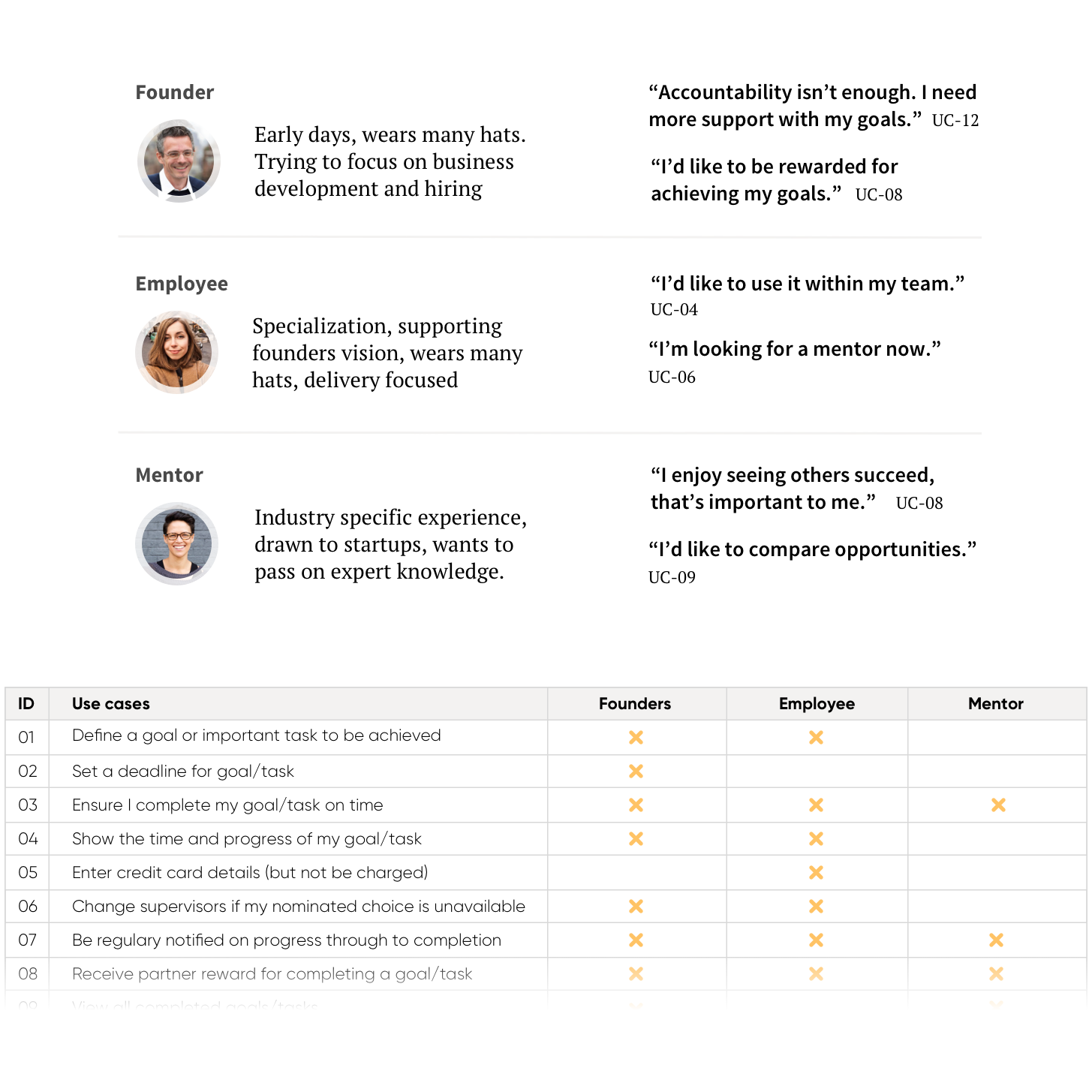
Interviewee statements translated into use cases: Founders, Employees, and Mentors.
Synthesis: Architecture
With use cases established across founders, employees, and mentors, I assembled userflows and built the information architecture. Every step in the sitemap was justified by data; if it wasn't in the use cases, it didn't make the cut.
Process
Open card sort. Conducted remotely via Trello cards with existing users to surface their mental model.
Closed card sort. Run as a workshop with the team to validate and refine groupings.
Tree test. Conducted remotely via Treejack to pressure-test the navigation structure before wireframing.
Sitemap. Final sitemap delivered based on all card sorting and use case data; every node earned its place.
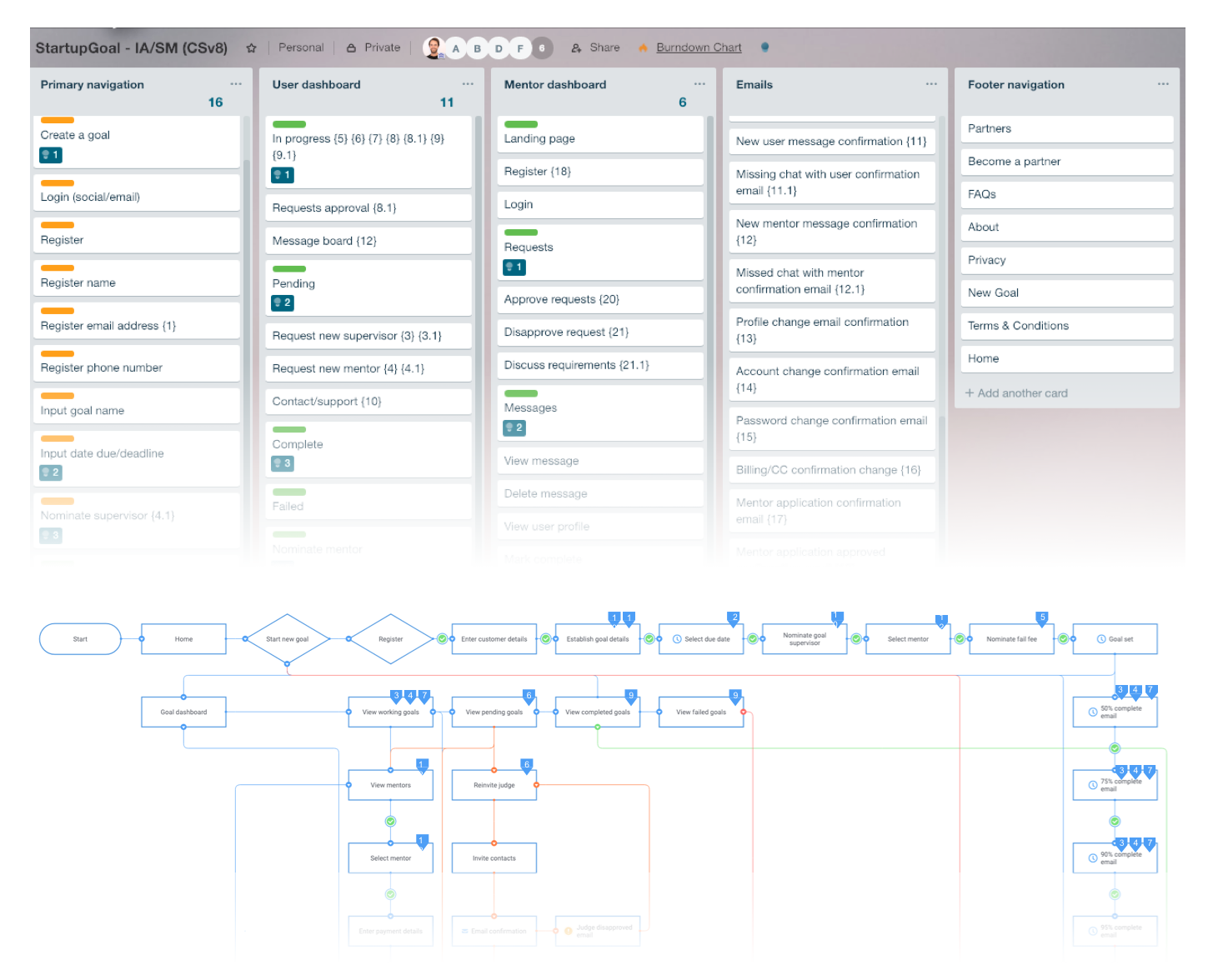
Open card sort and sitemap draft.
Prototype
Crazy 8s and other rapid ideation methods were used to explore key concepts. Insights from coaches shaped the goal-setting screens. Multiple rounds of user feedback refined the flows before a single pixel of UI was committed.
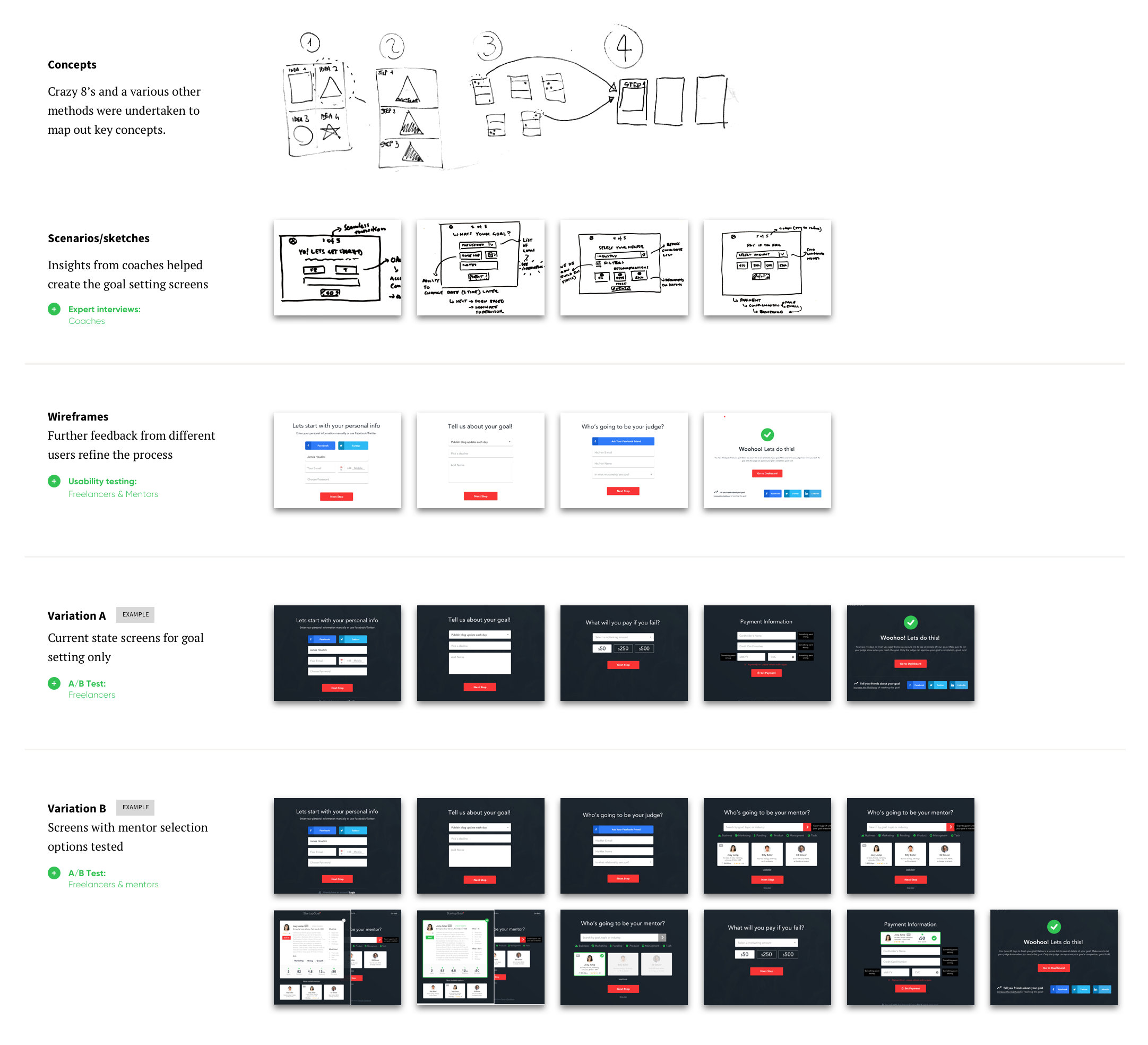
Concepts, scenarios, wireframes, and variations.
12
usability tests
50+
design tweaks
8
major redesigns
89%
final SUM score
Usability testing
With founders as the primary users, I recruited through partners, universities, and startup groups across Melbourne, conducting usability tests to assess time on task (ToT), error rates, completion rates, and satisfaction (SEQ).
Through iterative refinement, SUM scores improved from 82% to 89%, with multiple new subflows added and greater time-on-task offset by higher confidence and satisfaction scores.
Challenges
Users were reluctant to input credit card details without trialling a mentor first.
Hiring a mentor was 8 steps. It needed to be 3 to 5.
Building the full messaging function would have been costly and time-consuming at this stage.
What worked
Assessed 3 competing platforms with 5 current users to validate what was and wasn't working.
Communication board scoped to three core phase-1 features: messaging, file upload, and profile views.
Simpler scoping made the build viable without sacrificing the core value proposition.
Refinement & UI Design
Registration and payment were only one of multiple flows requiring redesign and testing. The in-product experience also required a full overhaul: mentor registration, mentor dashboard and subflows, the communication board, admin dashboards, account management, and notifications.
Key flows included User Dashboard, Mentor Dashboard, and Admin Dashboard views, all usability tested and A/B tested on sign-up flows for both user and mentor paths.
Hand-off
Functional specifications and clear naming conventions across the design system were developed to manage requirements with the engineering team. Exports were clean and consistently structured so engineers could track and deploy without ambiguity.
I worked with developers to unpack each epic, define stories, and assign time against each task, then co-ordinated and removed impediments through to delivery.
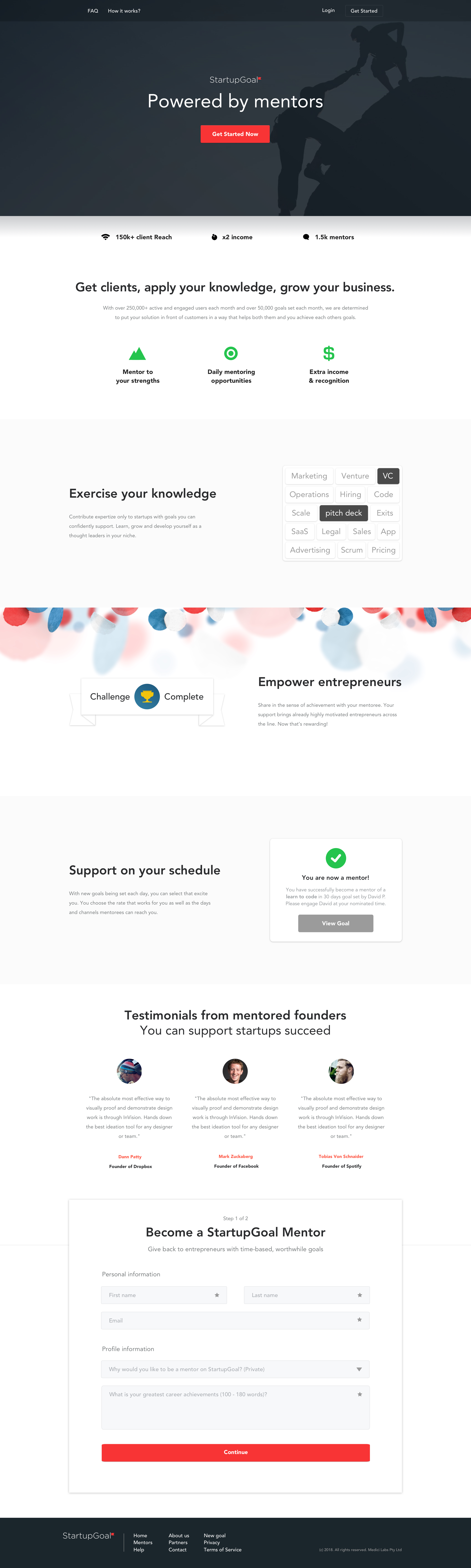
Mentor registration: full page.
A/B testing across the entire funnel
Every metric improved. Acquisition, Activation, Retention, Referral, and Revenue all moved in the right direction, the result of treating each decision as a testable hypothesis rather than a design preference.
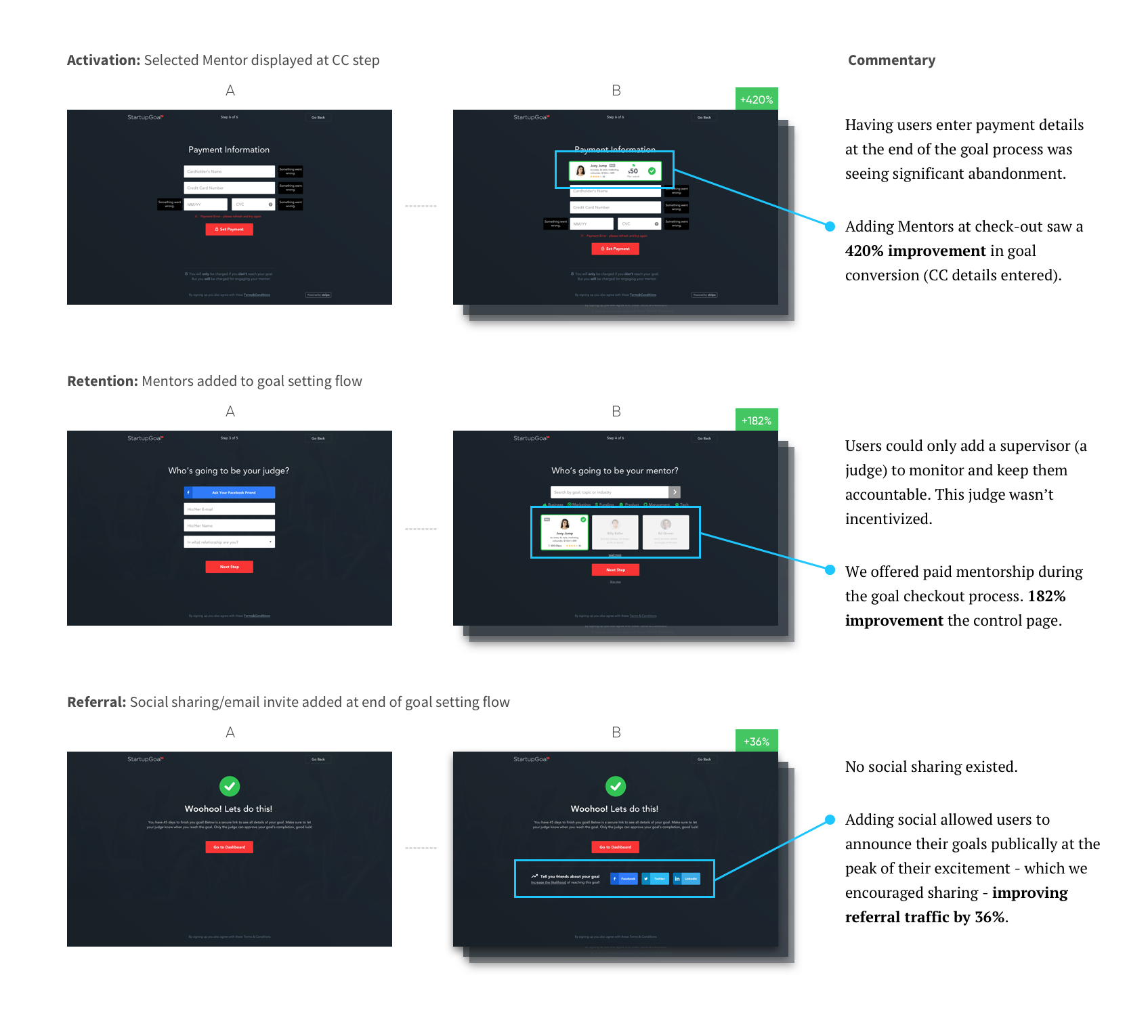
A/B testing artefacts and results documentation.
What worked, what failed
Retention required going back to users. Improving retention metrics meant returning to research to find out what else the basic accountability tool was missing. Adding mentor support was the answer.
Business coaches weren't the right fit. We assumed business coaches would support users. They saw it as a lead generation tool and tried to take users offsite, the wrong incentive entirely.
Mentors motivated by reciprocity, not money. Creating a clear incentive geared towards 'mentors', those with relevant industry experience looking to pay it forward, unlocked the right behaviour.
Product went to public beta. A/B testing drove Acquisition +32%, Activation +422%, Retention +180%, Referral +66%, and Revenue (MSPC) +210%. Significantly improved unit economics across the entire funnel.
This is the methodology I bring to your business. Without the enterprise headcount or three-month onboarding.
Anton's a high-class design leader who has worked in very challenging environments. He thrives when faced with challenges. User experience is his bread and butter, and he works tirelessly to champion that mindset. Put all this aside, and you're still graced with an A-grade charismatic person. I am better off having worked closely with him.
Jordan Barnard
Director, EY
Seen enough to have a conversation?
Get an experienced UX voice at your leadership table, without the full-time hire.